
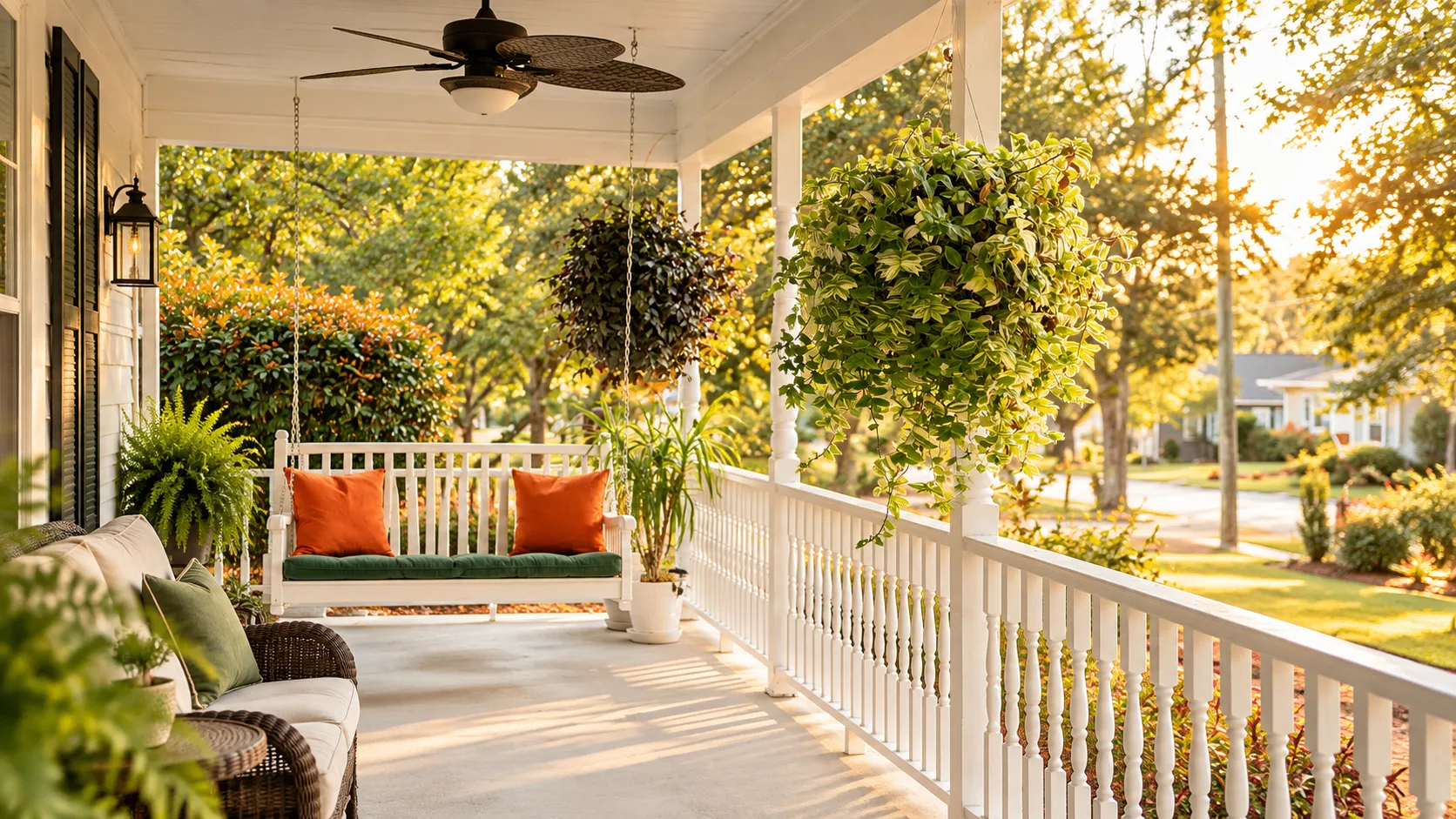
A front porch is a strange kind of room.
It belongs to the house, but it faces the world.
You can sit there without quite being inside or outside. You can greet someone arriving, finish a conversation before saying goodnight, drink your morning coffee, or stay for another half hour because nobody has given you a reason to get up yet.
Somewhere along the way, many porches became architectural decoration instead of places people actually use.
At The Magnolia Inn, the porch still has a job.
And on a house that has been standing since 1895, that feels exactly right.
A Porch Doesn’t Ask Much of You
A dining room has a purpose.
So does a bedroom.
Even a parlor suggests that you’ve intentionally gathered there.
The porch is different.
You don’t really need a reason to be on it.
That may be part of why conversation feels different there. Sitting on a porch doesn’t announce that everyone is about to have an important discussion. People simply end up beside each other.
One guest comes outside.
Someone else joins them.
Coffee appears.
Another chair gets pulled into the conversation.
Twenty minutes later, nobody quite remembers who came out first.
For a historic inn with seven individually appointed guest rooms, shared spaces like the porch matter. They give a stay somewhere to happen beyond the guest room itself.
The Best Part of a Gathering May Happen Outside the Schedule
Anyone who has hosted a wedding, reunion, birthday, or family weekend knows this.
The event has official moments.
There is dinner.
There is the toast.
There may be cake, photographs, gifts, or a ceremony.
But some of the moments people remember happen before and after those things.
Two relatives catch up while everyone else is getting ready.
A few wedding guests stay outside talking after the evening winds down.
Someone brings breakfast coffee onto the porch the next morning.
Nothing particularly dramatic happens.
That’s why it works.
The Magnolia Inn is designed around more than one gathering space. Guests can move between parlors, dining rooms, the porch, gardens, and their rooms rather than spending an entire occasion in a single event space.
The porch is often the least formal of them all.
And sometimes that’s exactly what a gathering needs.
A Wedding Ceremony Can Change the Porch Completely
Most days, a porch is simply a porch.
Then chairs appear.
Flowers are added.
Guests take their seats.
And suddenly the same place where someone had coffee that morning becomes part of a wedding.
The covered porch at The Magnolia Inn can take on that role beautifully because it already belongs to the house. It doesn’t feel like a separate ceremony structure that has been dropped onto the property for a few hours.
Afterward, it becomes a porch again.
People talk.
Photographs happen.
Someone steps outside between parts of the celebration.
That ability to change roles without losing its character is one of the things historic homes do especially well.
The Porch Changes an Overnight Stay, Too
A hotel gives you a room.
A good inn gives you places to be when you don’t particularly want to be in your room yet.
Maybe you’ve returned from dinner in downtown Clayton and the evening isn’t quite finished.
Maybe everyone else in your group is still getting ready.
Maybe breakfast is over, but you aren’t ready to head home.
The porch gives you somewhere to land.
That’s especially noticeable during group stays. When friends or family reserve rooms together, they don’t have to coordinate every conversation around a restaurant reservation or someone’s guest room.
They can simply find each other downstairs.
Sometimes in the parlor.
Sometimes around the breakfast table.
And sometimes on the porch.
Historic Houses Were Meant to Be Used
It would be easy to treat a house built in 1895 as something primarily to look at.
We would rather see people living in it.
The history of The Magnolia Inn is part of its character, but preserving a historic house doesn’t mean asking it to stop having a life.
The staircase should still carry footsteps.
The dining room should still have people around the table.
The front door should keep opening.
And the porch should still have someone sitting on it.
Perhaps that is what makes a historic inn different from simply visiting a historic building.
You don’t only observe the architecture.
For a night or a weekend, you get to use it.
Maybe the Front Porch Isn’t Lost After All
We probably don’t need to romanticize another era to understand why porches still appeal to us.
They give people somewhere to be without requiring much of them.
No reservation.
No agenda.
No reason to leave as soon as the planned activity is over.
At The Magnolia Inn, the porch has watched Clayton change for more than a century.
Today, it still welcomes arriving guests, conversations between friends, wedding moments, family gatherings, and the occasional person who intended to sit down for five minutes.
Some rooms are designed around what you’re supposed to do there.
A good porch leaves that part up to you.
Come Experience The Magnolia Inn
Stay in a historic inn in downtown Clayton and discover the spaces that make the house part of the trip—from the guest rooms and parlors to the porch waiting outside.
Explore Guest Rooms Discover Our Story Plan Your Stay
Leave a Reply